Transmission Line & Utility Construction
Certified patient transport that moves with your line crews, from the first tower to energization.
Transmission and utility crews work along long, remote rights-of-way, often hours from the nearest hospital and reached by right-of-way tracks or winter roads. When someone is hurt, the first hour depends on what's already on site.
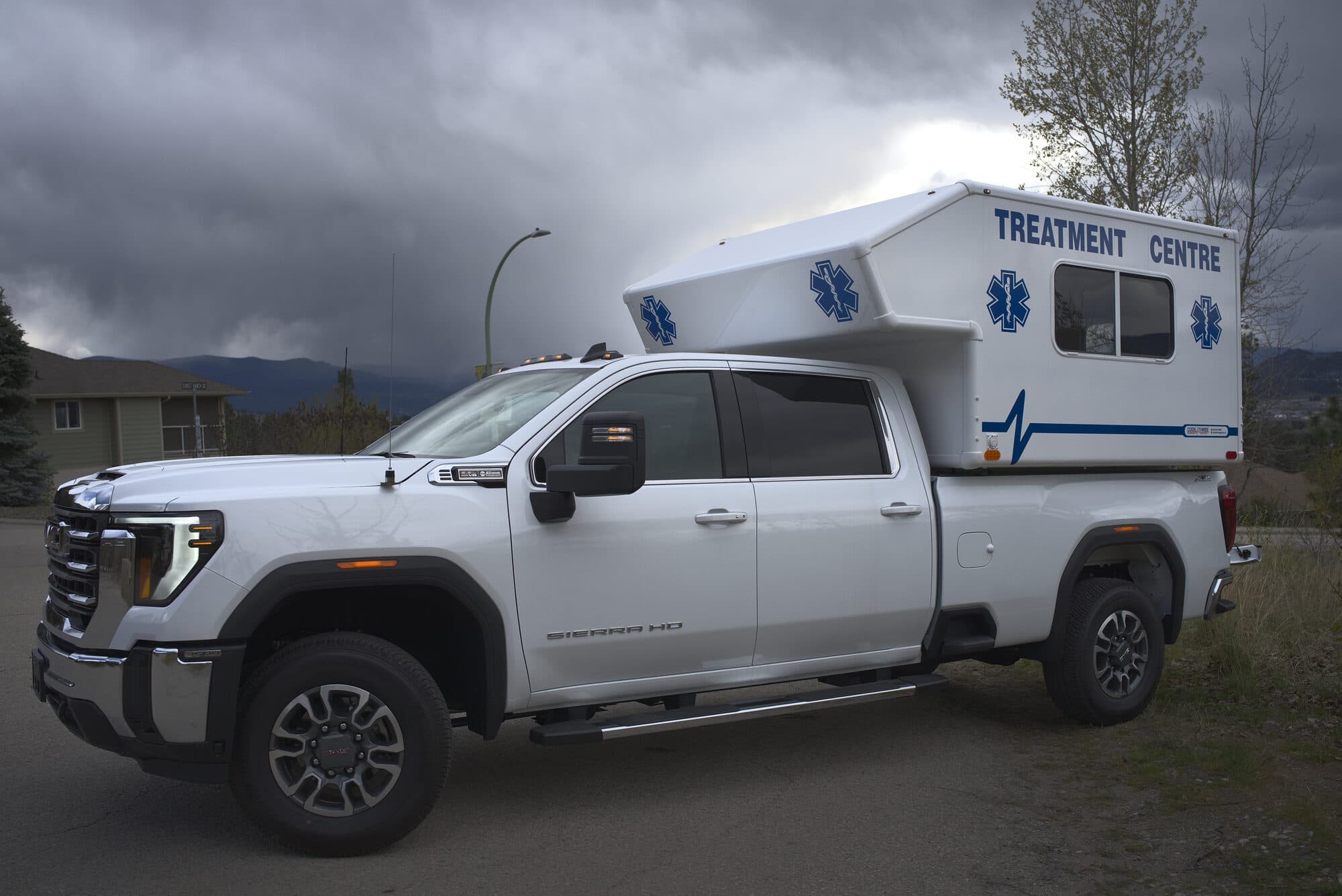
A Code Three Mobile Treatment Centre (MTC) turns a standard crew pickup into a certified patient transport and treatment unit. It slides in, ties down, and moves with the work as the crew advances along the line.
What makes line work different
- Linear worksites stretched over hundreds of kilometres, far from hospitals
- Access by right-of-way tracks, swamp mats and winter roads where ambulances can't go
- Crews that relocate every few days, so medical cover has to move with them
- High-consequence injuries: falls from height, electrical contact, heavy equipment
How the Code Three MTC helps
- Slides into standard full-size pickups (Ford F-250/350, GM 2500/3500, Ram 2500/3500) with no permanent modifications
- Dual stretcher capability and 72" of headroom for the attendant to work
- Certified to Canada Motor Vehicle Safety Standards (CMVSS) as an Emergency Transport Vehicle, and CSA certified
- Insulated and weatherproofed for -40°C winters and summer heat
- Delivered to Ontario in 4 to 6 weeks, with deployment support anywhere in Canada
Meeting your first aid and transport obligations
In BC and Alberta, the MTC meets WorkSafeBC (Levels 1, 2 and 3) and Alberta OHS requirements for remote worksites.
In Ontario, Regulation 1101 requires employers to provide first aid and to arrange transport for an injured worker. It doesn't name a specific vehicle. On remote rights-of-way, a certified MTC is a practical way to meet that transport duty and to back up your emergency response plan.
Where the work is in Ontario
Waasigan Transmission Line
Hydro One with nine First Nations partners. The Atikokan to Dryden phase is due in service by the end of 2027.
Wawa to Timmins (Porcupine) line
A 260 km line built to 500 kV standards, expected in service by the end of 2030.
Greenstone Transmission Line
Hydro One was directed to develop this northern line in January 2026.
Frequently asked questions
Have Code Three MTCs been used in Ontario?
Yes. Our units have been deployed on projects in Ontario, and we support MTC deployments across Canada.
How quickly can you deliver an MTC to Ontario?
Typically 4 to 6 weeks from order to delivery in Ontario.
Does it need a special truck?
No. The MTC slides into a standard full-size pickup bed (Ford F-250/350, GM 2500/3500, Ram 2500/3500) and ties down with no permanent modifications, so it can move between trucks.
Does an MTC meet Ontario's first aid rules?
Ontario's Regulation 1101 requires first aid and arranged transport for injured workers but doesn't specify a vehicle. Many remote-site plans use an MTC to cover the transport duty. Confirm the details with your safety team for your specific site.
Plan your site's emergency transport
Tell us where and when you're working. We'll recommend a configuration and give you a delivery date.